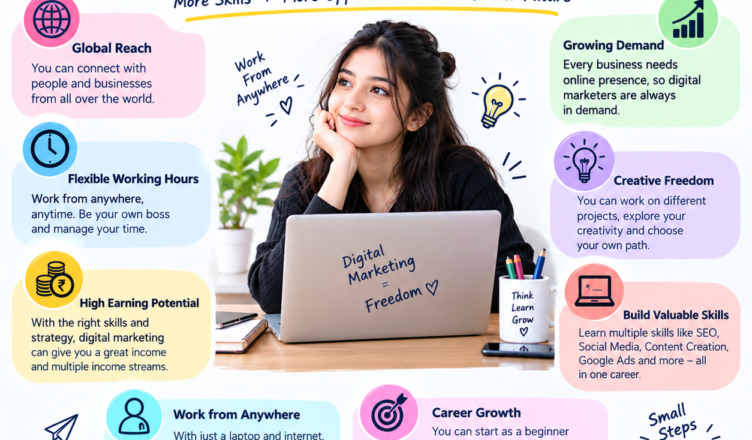
If you own a business or work in one, you have probably heard someone say, “You need to be online.” Maybe you have heard it so many times that it starts to feel like background noise. But here is the thing — that advice is not wrong. It is just not explained well enough.
Digital marketing is not some mysterious magic trick. It is simply the process of promoting your business, product, or service using the internet and digital tools. And when done right, it can genuinely change the way your business grows.
I remember talking to a small bakery owner a while back. She had been running her shop for six years purely on word of mouth. Business was okay, but it had hit a ceiling. Within four months of starting a simple Instagram page and running small paid ads, her orders doubled. She did not do anything fancy. She just showed up where her customers already were — online.
That story is not unique. It is happening all over the world, across industries big and small. So let us break down the real benefits of digital marketing in a way that actually makes sense.
What Exactly Is Digital Marketing?
Before we get into the benefits, it helps to know what we are actually talking about.
Digital marketing covers a wide range of activities:
- Search engine optimization (SEO) — getting your website to show up on Google
- Social media marketing — using platforms like Facebook, Instagram, LinkedIn, or TikTok
- Email marketing — sending targeted messages to your audience
- Content marketing — writing blogs, making videos, creating useful content
- Pay-per-click advertising (PPC) — running paid ads on Google or social media
- Affiliate marketing — partnering with others to promote your products
All of these fall under the digital marketing umbrella. You do not have to do all of them at once. Most businesses start with one or two and grow from there.
Benefit 1: You Can Reach a Much Larger Audience
One of the most obvious but still exciting benefits of digital marketing is reach.
With traditional marketing — think flyers, local newspaper ads, or a billboard on the highway — your audience is limited by geography. You can only reach the people who drive past that billboard or live in the area where you hand out flyers.
Digital marketing breaks that limit completely.
A small handmade jewelry brand sitting in a small town in Ohio can sell to customers in New York, London, and Tokyo — all through a well-run Instagram account and a simple online store. That kind of reach used to be reserved only for big companies with massive advertising budgets. Now, it is available to almost everyone.
“The internet does not care how big your budget is. It cares about how relevant and helpful you are to your audience.”
Of course, reaching a larger audience only matters if you are reaching the right people. Which brings us to the next point.
Benefit 2: You Can Target Exactly Who You Want
This is, in my opinion, one of the most powerful things about digital marketing that people do not fully appreciate until they experience it.
When you run a Facebook or Google ad, you do not just blast your message out to everyone and hope for the best. You can get incredibly specific about who sees your content.
Want to show your ad only to:
- Women between 25 and 40 years old
- Who live within 20 miles of your store
- Who have shown interest in yoga, organic food, or wellness products?
You can do that. Seriously.
Compare that to placing an ad in a local newspaper. You have no real control over who reads it. You are paying for everyone — including people who will never be your customer.
Digital marketing lets you put your message in front of people who are most likely to care about what you offer. That means less money wasted and better results overall.
This kind of targeted marketing also means your campaigns become smarter over time. As you learn more about who responds to your content, you can refine your targeting further and make each campaign more effective than the last.
Benefit #3: It Is Much More Affordable Than Traditional Marketing
Let us talk about money, because that matters a lot — especially for small businesses.
Traditional advertising is expensive. A 30-second TV commercial can cost thousands of dollars just to produce, and then you have to pay to air it. A full-page magazine ad can run you several thousand dollars. Even a local radio spot adds up quickly.
Digital marketing operates on a very different scale.
- You can start a blog for free
- You can post on social media for free
- You can run a Facebook ad for as little as five dollars a day
- You can send an email campaign to thousands of people for a few dollars a month
Now, I am not saying digital marketing is free. Good content takes time, and well-run paid campaigns do cost money. But compared to traditional media, the entry point is dramatically lower.
A startup with a tight budget can still build a real online presence and attract paying customers. That is something traditional