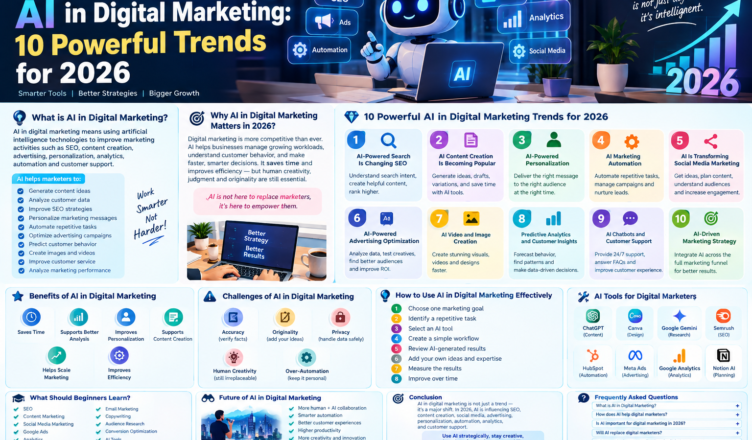
Artificial intelligence is changing the way businesses attract customers, create content, analyze data, and run online campaigns. From automated customer support to AI-powered search and personalized advertising, businesses are using artificial intelligence to make digital marketing faster and more efficient.
AI in Digital Marketing is no longer just a future idea. It is becoming an important part of modern marketing strategies. In 2026, marketers can use AI to understand customer behavior, generate content ideas, improve search engine optimization, optimize advertising campaigns, and automate repetitive tasks.
In this guide, we will explore 10 powerful AI in digital marketing trends for 2026 and explain how businesses and marketers can use them effectively.
Table of Contents
Toggle1. AI-Powered Search Is Changing SEO
One of the biggest developments in digital marketing is the growth of AI-powered search experiences.
Search engines are increasingly using AI to understand the meaning behind a search instead of simply matching individual keywords. This means marketers need to create content that directly answers users’ questions and provides useful information.
Traditional keyword optimization is still important, but modern SEO requires more than repeating a keyword.
Successful content should be:
- Helpful
- Original
- Easy to understand
- Well structured
- Relevant to search intent
- Supported by trustworthy information
How Marketers Can Adapt
Businesses should focus on answering real customer questions and creating comprehensive content around important topics.
Use clear headings, short paragraphs, FAQs, examples, and useful explanations. Instead of writing only for search engines, create content that genuinely helps readers.
This approach can make your website more useful and improve its chances of being discovered through changing search experiences.
2. AI Content Creation Is Becoming More Popular
AI content creation is another major trend in digital marketing.
AI tools can help marketers generate blog ideas, outlines, social media concepts, email drafts, ad variations, and other content.
However, simply publishing AI-generated text is not enough.
Human editing remains important because AI-generated content can sometimes be inaccurate, repetitive, or too generic.
A Better AI Content Workflow
A strong workflow can look like this:
- Research the audience.
- Identify a useful topic.
- Create an outline.
- Use AI for brainstorming or drafting.
- Add personal experience and original insights.
- Check facts and information.
- Improve readability.
- Optimize the content for SEO.
- Add relevant images and examples.
- Review the final article before publishing.
AI can make content creation faster, but human creativity helps make content valuable and distinctive.
3. AI-Powered Personalization
Customers increasingly expect businesses to provide relevant experiences.
AI can analyze customer behavior and help businesses personalize marketing messages based on interests, interactions, and preferences.
For example, an online store may use customer activity to recommend products that are relevant to a visitor.
Personalization can also be used in:
- Email marketing
- Product recommendations
- Website experiences
- Advertising
- Social media campaigns
- Customer communication
Why Personalization Matters
When customers receive relevant information instead of generic messages, marketing communication can become more useful.
The goal is not simply to show customers more advertisements. The goal is to deliver the right information to the right audience at the right time.
Why Personalization Matters
When customers receive relevant information instead of generic messages, marketing communication can become more useful.
The goal is not simply to show customers more advertisements. The goal is to deliver the right information to the right audience at the right time.
4. AI Marketing Automation
Marketing automation has been around for years, but AI is making automation more intelligent.
AI can help marketers automate repetitive activities such as customer segmentation, campaign analysis, content suggestions, and routine communication.
For example, a business may create an automated workflow that sends different messages depending on how a customer interacts with its website.
Benefits of AI Automation
AI marketing automation can help businesses:
- Save time
- Reduce repetitive work
- Improve campaign management
- Analyze customer behavior
- Organize leads
- Deliver timely communication
- Scale marketing activities
Automation should support marketers rather than remove human oversight.
Important customer communication should still be reviewed to make sure it is accurate, appropriate, and useful.
5. AI Is Transforming Social Media Marketing
Social media marketers have to create content regularly and understand what their audiences want.
AI can help with social media research, content ideas, captions, audience analysis, and campaign planning.
For example, marketers can use AI to brainstorm multiple content ideas from one topic.
One blog article could become:
- An Instagram post
- A LinkedIn post
- A short video idea
- A carousel
- A Facebook post
- A discussion question
This can help marketers turn one piece of content into multiple formats.
The Human Element Still Matters
Social media is about people, not just algorithms.
AI can help generate ideas, but authentic stories, opinions, experiences, and conversations are what make social media content more engaging.
6. AI-Powered Advertising Optimization
Paid advertising platforms are increasingly using automation and machine learning to help advertisers optimize campaigns.
AI can analyze campaign signals and help identify patterns related to audiences, placements, creative assets, and performance.
Marketers can also use AI to create different versions of advertising copy and creative concepts for testing.
How AI Can Help Advertisers
AI can support:
- Audience analysis
- Ad copy ideas
- Creative variations
- Campaign optimization
- Performance analysis
- Budget planning
- Testing ideas
However, marketers should continue monitoring campaign results instead of blindly trusting automated recommendations.
A good advertising strategy combines platform automation with human decision-making.
7. AI Video and Image Creation
Visual content has become an important part of digital marketing.
AI-powered creative tools can help marketers develop images, videos, designs, storyboards, and creative concepts more quickly.
Small businesses can benefit because they may not have large design or production teams.
AI can help with:
- Social media graphics
- Product concepts
- Video scripts
- Storyboards
- Ad concepts
- Blog illustrations
- Presentation visuals
The most effective approach is to use AI as a creative assistant while maintaining brand consistency and checking content before publishing.
8. Predictive Analytics and Customer Insights
Marketing generates huge amounts of data.
AI can help businesses analyze that data and identify patterns that may be difficult to notice manually.
Predictive analytics can help marketers understand potential customer behavior and make better decisions.
For example, businesses can analyze information related to:
- Website visits
- Customer interactions
- Campaign performance
- Purchase behavior
- Engagement
- Conversion trends
Instead of only asking what happened in the past, marketers can use data analysis to think about what may happen next.
Better Data, Better Decisions
AI is most useful when businesses provide accurate and relevant data.
Marketers should not assume that every AI prediction is automatically correct. Data quality, context, and human judgment remain important.
Why AI Chatbots Matter
Customers often want quick answers.
A well-designed chatbot can provide assistance at any time while reducing the amount of repetitive work handled manually.
However, customers should have a clear way to reach a human when their question is complex or sensitive.
Why AI Chatbots Matter
Customers often want quick answers.
A well-designed chatbot can provide assistance at any time while reducing the amount of repetitive work handled manually.
However, customers should have a clear way to reach a human when their question is complex or sensitive.
Benefits of AI in Digital Marketing
AI provides several potential benefits for businesses and marketers.
1. Saves Time
AI can automate repetitive tasks and help marketers complete routine work faster.
2. Supports Better Analysis
AI can process large amounts of information and identify patterns that can support decision-making.
3. Improves Personalization
Businesses can use AI to deliver more relevant experiences to different customer groups.
4. Supports Content Creation
AI can help marketers brainstorm ideas, create outlines, and develop content variations.
5. Helps Scale Marketing
AI can make it easier for small teams to manage multiple marketing activities.
6. Improves Efficiency
By reducing repetitive work, marketers can spend more time on strategy, creativity, and customer relationships.
Challenges of AI in Digital Marketing
Although AI provides many opportunities, marketers should also understand its limitations.
Accuracy
AI-generated information can sometimes contain errors. Important facts should always be checked before publishing.
Originality
Using AI without adding original ideas can result in generic content.
Privacy
Businesses should handle customer data responsibly and follow applicable privacy requirements.
Human Creativity
AI can generate ideas, but human experience, creativity, empathy, and judgment remain extremely important.
Over-Automation
Automating everything can make marketing feel impersonal. Customers still value genuine human communication
How to Use AI in Digital Marketing Effectively
If you are a beginner, you do not need dozens of AI tools.
Start with one or two specific marketing tasks.
For example:
Step 1: Choose one marketing goal.
Step 2: Identify a repetitive task.
Step 3: Select an AI tool that can help with that task.
Step 4: Create a simple workflow.
Step 5: Review AI-generated results.
Step 6: Add your own ideas and expertise.
Step 7: Measure the results.
Step 8: Improve the workflow over time.
This approach is better than using AI simply because it is trending.
AI in Digital Marketing: What Should Beginners Learn?
If you are learning digital marketing in 2026, focus on the fundamentals first.
Learn:
- SEO
- Content marketing
- Social media marketing
- Google Ads
- Analytics
- Email marketing
- Copywriting
- Audience research
- Conversion optimization
- AI tools
AI works best when you already understand the marketing problem you are trying to solve.
For example, learning an AI writing tool is useful, but understanding your target audience and search intent is even more important.
Future of AI in Digital Marketing
The future of digital marketing will likely involve closer cooperation between people and AI.
AI can handle large amounts of data and repetitive activities, while humans provide creativity, strategy, empathy, and judgment.
Marketing professionals who learn how to work with AI may be able to become more productive and focus on higher-value activities.
The goal should not be to replace every human task with AI. Instead, businesses should identify where AI can create genuine value.
Conclusion
AI in Digital Marketing is becoming one of the most important developments in modern marketing. In 2026, AI is influencing SEO, content creation, social media, advertising, personalization, automation, analytics, customer support, and creative production.
The 10 major trends covered in this article show that AI is becoming part of almost every stage of the digital marketing process.
However, successful AI marketing is not simply about using the newest tools. It is about using technology strategically while maintaining accuracy, originality, privacy, and human creativity.
If you are a beginner, start small. Choose one marketing task, use AI to improve your workflow, measure the results, and continue learning.
The marketers who combine AI technology with strong marketing fundamentals will be better prepared for the changing digital landscape.
Frequently Asked Questions
What is AI in Digital Marketing?
AI in digital marketing means using artificial intelligence technologies to improve marketing activities such as SEO, content creation, advertising, personalization, analytics, automation, and customer support.
How does AI help digital marketers?
AI can help digital marketers automate repetitive tasks, analyze data, generate ideas, personalize customer experiences, optimize campaigns, and improve productivity.
Is AI important for digital marketing in 2026?
Yes. AI is becoming increasingly integrated into search, advertising, content creation, analytics, automation, and customer experiences.
Will AI replace digital marketers?
AI is more likely to change many marketing tasks than completely replace digital marketers. Human creativity, strategy, judgment, communication, and understanding of customers remain important.
What are the best AI applications in digital marketing?
Some important applications include AI-powered SEO, content creation, marketing automation, advertising optimization, personalization, customer support, predictive analytics, and social media management
Final Thoughts
AI is changing digital marketing quickly, but the fundamentals remain important. Understand your audience, create useful content, measure your performance, and use AI as a tool to improve your work.
Start learning today, experiment responsibly, and keep improving your digital marketing skills.