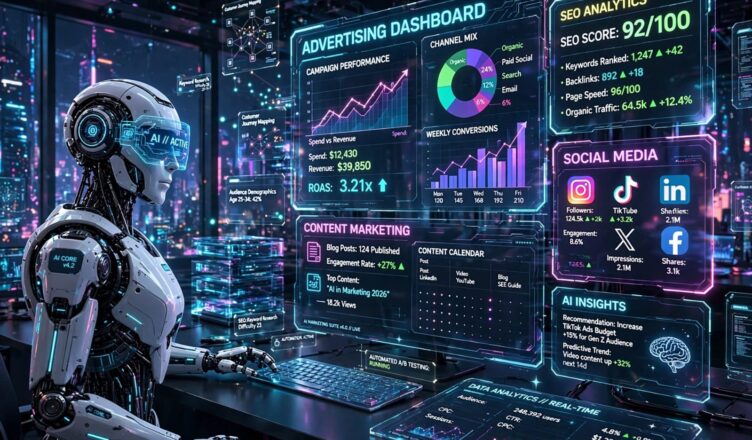
Artificial Intelligence (AI) is changing the way businesses attract customers, create content, analyze data, and grow online. Digital marketing has always depended on technology, but AI is making marketing faster, smarter, and more personalized.
From writing content and creating advertisements to understanding customer behavior and improving search engine rankings, AI digital marketing tools can help businesses save time and make better decisions.
In this guide, we will explain what AI digital marketing is, how it works, its benefits, important AI marketing tools, practical strategies, challenges, and how beginners can start using AI effectively.
Table of Contents
ToggleWhat Is AI Digital Marketing?
What Is AI Digital Marketing?
The goal is not simply to replace marketers. Instead, AI can help marketers work more efficiently and spend more time on strategy, creativity, and building relationships with customers.
[No.1 AI Digital Marketing: The Complete Guide for Beginners and Businesses]
Why Is AI Important in Digital Marketing?
The internet produces enormous amounts of data every day. Businesses need to understand this information to make good marketing decisions.
AI can analyze information much faster than a person can manually process it. It can help identify customer interests, recognize patterns, generate ideas, and automate repetitive tasks.
For example, an online business may receive thousands of website visitors every month. AI-powered analytics can help marketers understand which pages visitors prefer, what type of content attracts attention, and where potential customers leave the website.
This information can then be used to improve the marketing strategy.
AI is especially useful because modern customers expect relevant and personalized experiences. Instead of showing exactly the same message to everyone, businesses can use data and AI-assisted tools to create more relevant marketing experiences.
The internet produces enormous amounts of data every day. Businesses need to understand this information to make good marketing decisions.
AI can analyze information much faster than a person can manually process it. It can help identify customer interests, recognize patterns, generate ideas, and automate repetitive tasks.
For example, an online business may receive thousands of website visitors every month. AI-powered analytics can help marketers understand which pages visitors prefer, what type of content attracts attention, and where potential customers leave the website.
This information can then be used to improve the marketing strategy.
AI is especially useful because modern customers expect relevant and personalized experiences. Instead of showing exactly the same message to everyone, businesses can use data and AI-assisted tools to create more relevant marketing experience
AI is influencing almost every major area of digital marketing.
1. AI Content Creation
Creating high-quality content consistently can take a lot of time. AI writing tools can help marketers generate content ideas, outlines, headlines, product descriptions, social media posts, email drafts, and blog structures.
However, AI-generated content should not simply be copied and published without review.
A good process is:
- Research the topic.
- Use AI to generate ideas.
- Create an initial draft.
- Check facts and accuracy.
- Add personal experience and original insights.
- Edit the content for clarity.
- Optimize it for the target audience.
2. AI for SEO
Search engine optimization is one of the most important digital marketing strategies.
AI can assist with several SEO activities, including:
- Keyword research
- Content planning
- Search intent analysis
- Topic clustering
- Meta title ideas
- Meta descriptions
- Content optimization
- Competitor research
- Internal linking suggestions
- Content gap analysis
For example, if you are writing an article about digital marketing, AI can help you identify related topics such as SEO, social media marketing, PPC, content marketing, email marketing, conversion optimization, and marketing analytics.
AI should support SEO research rather than replace the need for useful, original content.[
[No.1 AI Digital Marketing: The Complete Guide for Beginners and Businesses]
3. AI-Powered Social Media Marketing
Social media marketing requires regular content, creative ideas, audience research, and performance analysis.
AI can help marketers plan social media campaigns and generate content ideas for platforms such as Instagram, Facebook, LinkedIn, YouTube, and X.
AI can assist with:
- Post ideas
- Captions
- Hooks
- Content calendars
- Hashtag research
- Video concepts
- Short-form content ideas
- Audience analysis
- Performance analysis
For example, a digital marketing freelancer could use AI to create a 30-day content plan covering educational posts, engagement posts, industry tips, case studies, and promotional content.
The marketer can then customize each post according to their brand voice and audience.
4. AI in Google Ads and PPC Marketing
Paid advertising is another area where AI has become increasingly important.
Advertising platforms use machine learning to help optimize campaigns based on signals such as audience behavior, search activity, device, location, and other available information.
AI tools can also help marketers with:
- Ad copy ideas
- Keyword research
- Audience research
- Campaign planning
- Performance analysis
- Conversion analysis
- Testing ideas
- Budget planning
For example, a business selling website design services could create several advertising messages for different customer needs.
One advertisement might focus on getting more leads, while another might focus on building a professional online presence.
The marketer can then test different messages and use campaign data to determine what performs better.
5. AI Chatbots and Customer Support
Customer communication is extremely important for online businesses.
AI-powered chatbots can answer common questions, provide basic information, guide website visitors, and help businesses respond more quickly.
For example, a website visitor may ask:
- What services do you provide?
- How can I contact you?
- What is your pricing?
- How long does a project take?
- How can I place an order?
An AI chatbot can handle many routine questions while more complicated issues can be transferred to a human team member.
This can improve response time and provide customers with assistance outside normal working hours.
6. AI Email Marketing
Email marketing becomes more effective when messages are relevant to the recipient.
AI can help marketers analyze customer behavior and create personalized email campaigns.
It can assist with:
- Subject line ideas
- Email content
- Audience segmentation
- Personalized recommendations
- Campaign timing
- A/B testing ideas
- Customer behavior analysis
For example, an online store may send different emails to new customers, returning customers, and people who have shown interest in particular products.
Personalization can make marketing communication more useful and relevant.
7. AI for Customer Research
Understanding the target audience is one of the foundations of successful marketing.
AI can help marketers organize and analyze customer information to identify common interests, questions, problems, and preferences.
Before creating a campaign, a marketer can research:
- Who is the target audience?
- What problem are they trying to solve?
- What motivates them?
- What questions do they ask?
- What alternatives are they considering?
- What type of content do they consume?
These insights can help businesses create stronger marketing messages.
Benefits of AI Digital Marketing
AI can automate repetitive tasks such as generating ideas, summarizing information, organizing data, and creating initial drafts.
This allows marketers to focus on higher-value activities.
Improves Productivity
Instead of spending hours starting a task from scratch, marketers can use AI to create a starting point and then improve it.
Supports Better Decisions
AI can analyze large amounts of data and identify patterns that may be difficult to notice manually.
Enables Personalization
Businesses can create more relevant experiences based on customer interests and behavior.
Helps Small Businesses
Small businesses often have limited budgets and marketing teams. AI tools can help them perform certain tasks more efficiently.
Supports Faster Content Production
AI can help marketers generate ideas and drafts quickly, making it easier to maintain a consistent content strategy.
Helps Campaign Optimization
AI-assisted tools can analyze marketing performance and provide insights that help marketers improve campaigns.
Popular Types of AI Digital Marketing Tools
There are many categories of AI tools available to marketers.
AI Writing Tools
These tools can assist with blog ideas, social media content, emails, product descriptions, and other written material.
AI Image and Design Tools
AI-powered design tools can help create marketing graphics, social media visuals, advertisements, and creative concepts.
AI Video Tools
Video-focused AI tools can assist with scripts, editing, subtitles, animations, and other parts of video production.
AI SEO Tools
These tools can support keyword research, content optimization, competitor analysis, and SEO planning.
AI Analytics Tools
Analytics and machine-learning systems can help marketers understand customer behavior and campaign performance.
AI Chatbots
Chatbots can provide automated responses and assist with customer communication.
How to Use AI in a Digital Marketing Strategy
Using AI successfully requires more than simply opening an AI tool and asking it to create content.
A structured process works better
Step 1: Define Your Marketing Goal
First decide what you want to achieve.
Your goal could be:
- Increase website traffic
- Generate leads
- Increase sales
- Improve brand awareness
- Grow social media followers
- Improve customer engagement
A clear goal makes it easier to choose the right tools and measure success.
Step 2: Understand Your Audience
Identify your target customers and understand their needs, interests, and problems.
Step 3: Choose the Right AI Tools
Do not use every AI tool available. Select tools that solve specific problems in your marketing workflow.
Step 4: Create and Review Content
Use AI to assist with content creation, but always review the output.
Check:
- Accuracy
- Grammar
- Originality
- Brand voice
- Relevance
- Facts
- Customer usefulness
Step 5: Publish and Test
After publishing your content or launching your campaign, monitor its performance.
Step 6: Analyze the Results
Look at relevant metrics such as:
- Website traffic
- Click-through rate
- Conversion rate
- Cost per click
- Cost per lead
- Engagement
- Sales
- Return on advertising spend
Step 7: Improve Your Strategy
Use performance data to identify what is working and what needs improvement.
AI can assist with analysis, but marketers should make decisions based on business goals and reliable data.
AI Digital Marketing for Beginners
Beginners do not need to learn dozens of AI tools at once.
Start with the basics of digital marketing first.
Learn about:
- Digital marketing fundamentals
- SEO
- Social media marketing
- Content marketing
- Google Ads
- Email marketing
- Analytics
- Conversion optimization
Then learn how AI can support each area.
For example, if you are learning social media marketing, start by understanding audience research, content strategy, engagement, and analytics. Then use AI tools to help generate ideas and analyze your work.
This approach helps you understand the marketing principles instead of becoming completely dependent on AI.
AI and Human Creativity
One of the biggest misunderstandings about AI digital marketing is that AI can completely replace marketers.
Marketing is not only about producing content.
Successful marketing requires:
- Creativity
- Strategy
- Communication
- Emotional understanding
- Brand knowledge
- Critical thinking
- Decision-making
- Customer relationships
AI can generate ideas, but humans need to decide which ideas are useful.
For this reason, the future of digital marketing is likely to involve humans and AI working together.
Challenges of AI Digital Marketing
AI also has limitations.
Accuracy Problems
AI can sometimes produce incorrect or outdated information. Important facts should always be verified.
Lack of Originality
If businesses publish generic AI-generated content without adding their own perspective, their content may fail to stand out.
Privacy Concerns
Businesses must handle customer information responsibly and follow applicable privacy and data-protection requirements.
Overdependence on AI
Marketers should not rely completely on AI. Human judgment remains important.
Brand Voice
AI-generated content may sound generic unless it is properly guided and edited.
The Future of AI Digital Marketing
AI will continue to influence the future of online marketing.
Businesses are likely to use AI increasingly for automation, personalization, customer insights, content production, advertising optimization, and marketing analytics.
At the same time, marketers who understand strategy and know how to use AI responsibly will have an important advantage.
The most valuable skill will not simply be knowing how to use an AI tool. It will be knowing what to ask, why to use it, how to evaluate the result, and how to turn the result into meaningful marketing action.
Final Thoughts
AI digital marketing is changing the way businesses promote their products and services online. From content creation and SEO to social media, advertising, email marketing, analytics, and customer support, AI can help marketers work faster and more efficiently.
However, AI should be treated as a marketing assistant rather than a complete replacement for human creativity and strategy.
For beginners, the best approach is to learn digital marketing fundamentals and gradually add AI tools to the workflow.
The future belongs to marketers who can combine human creativity + marketing knowledge + AI technology + data-driven decision-making.
If you are learning digital marketing or building a freelancing career, learning how to use AI effectively can become an important part of your skill set.
Start small, practice regularly, test your results, and keep learning. AI is not just a trend—it is becoming an important part of the modern digital marketing ecosystem.